A local AI grading assistant
An AI agent on my own hardware that grades homeschool coursework in an online school platform, under rules and safety checks that came from its own mistakes.
Moving to Zambales came with a few strict requirements, and one of the most important was our kids’ education. We decided the best way to handle it was homeschooling, through the homeschool programme and online classes we chose, rather than a local school.
That decision worked. It also left us with a lot of grading.
01
The problem
Grading homeschool work takes hours. For each subject you find the right page of the teacher’s answer key, check every answer, score the essays, add it all up and enter it into the school’s online platform, day after day, subject after subject.
I wanted to see whether an AI agent could do the routine part reliably, with a person still in charge. Not a chatbot giving advice, but an agent that actually signs in, reads the work and enters the grades.
02
Running it locally
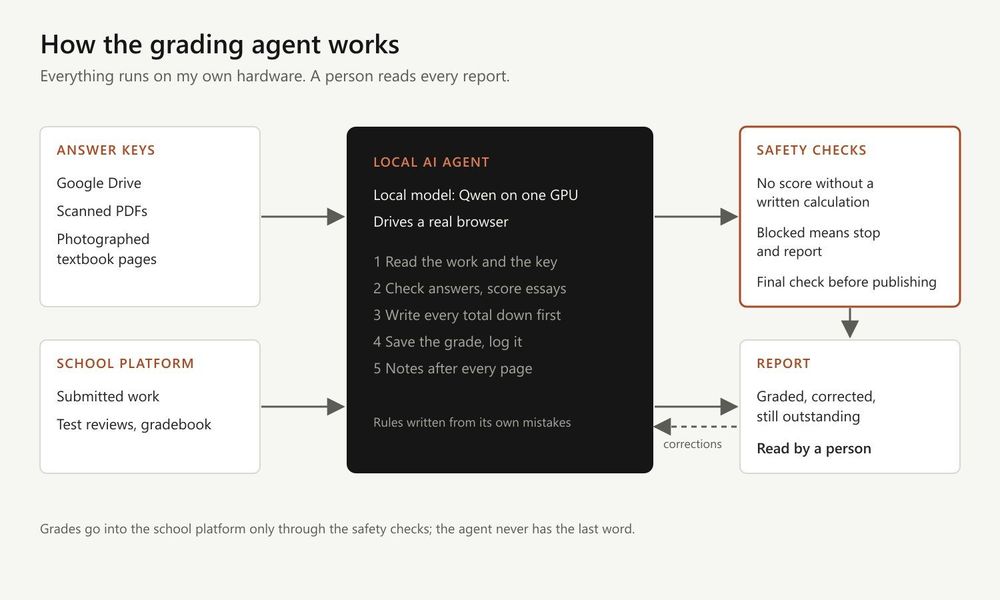
It runs entirely on my own hardware. The model is a local one, Qwen, served through Strata and driven by the DSH agent harness, on a single graphics card at home. The coursework never goes to an outside AI service.
That was a deliberate choice. Schoolwork is personal, and I wanted to know whether a local model, smaller than the big cloud ones, could handle this kind of careful, multi-step work. In my experience it can, with a lot of structure around it.
03
What it does
The agent signs in to the school platform through a real browser, the same way a parent would, and reads the student’s submitted work and test reviews. It finds the matching answer keys in Google Drive, in scanned PDFs, or on photographed textbook pages.
It checks each answer, scores essays, and works out every total in writing before it types a single number. Each saved grade goes into a ledger: what changed, from what to what, and the calculation behind it.
At the end of each session it updates a progress report: what was graded, the results, the corrections, and what’s still outstanding. I read that report. The agent doesn’t get the last word.
04
Rules from mistakes
The interesting part has been making it trustworthy, and almost all of that came from its mistakes. Some of them: it downloaded the platform’s login page five times and saved it as five “answer keys”. It invented a web address and retried it 25 times. It garbled every page of the report by saving text in the wrong encoding. It labelled one evening’s work with four different dates. And once it saved a score for a lab that didn’t exist, which dropped a whole course by a grade.
Each mistake became a written rule in its instructions, with the incident explained, and the serious ones became checks it can’t get around. The browser now refuses any score that doesn’t have a recorded calculation behind it, and when a safety check blocks something, the agent has to stop and report instead of improvising. It’s also forbidden from opening any link that could reset a student’s test. Before anything is published, a final check compares what the platform shows with what the agent says it did.
It also has to cope with its own memory. Long sessions fill the model’s working memory, and when that gets compacted, everything it read but didn’t write down is gone. So it writes as it goes: a notes file after every page it reads, and a list of everything it has saved, which it trusts over its own summary.
Not many people are running this kind of agent on their own hardware yet. Most of what I’ve learned is about the guard rails rather than the model.